01

Core Philosophy

Friction Bloom is built on a single premise: controlled disruption produces emergent structure. Most algorithms optimize for speed, efficiency, and convergence. Friction Bloom does the opposite — it introduces deliberate obstacles and measures what happens when an agent can no longer take the easy path.

The name comes from the outcome state it seeks to induce. A Bloom occurs when an agent, forced off its baseline route by friction, discovers a novel viable path it would never have found without the disruption. The disruption is not a failure condition. It is the experimental variable.

This framework draws directly from cognitive science and experimental psychology — stimulus, perturbation, adaptation, outcome. The same behavioral architecture that governs human response to constraint governs autonomous agent pathfinding. Friction Bloom makes that connection explicit and measurable.

Bloom
Agent recovered through a novel viable route. High novelty with maintained coherence.
Novelty greater than 0.35 — Chaos at 0.0
Stable
Behavior remains mostly unchanged under constraint. Friction did not meaningfully alter the baseline path.
Novelty less than 0.10
Noise
Behavior changed but adaptation was weak or inefficient. The agent reacts but the altered route lacks adaptive value.
Novelty between 0.10 and 0.33
Collapse
The system fails to recover under pressure. Utility recovery fails — constraint exceeds adaptive capacity.
Utility recovery failure
02

Metric Framework

4.0
Bloom Score
Composite index of emergent path quality. Floor of 2.0 for all Stable outcomes. Scales toward 4.0 in high-performance adaptations.
0.65
Max Novelty
Spatial divergence between baseline and perturbed path. Scores above 0.35 signal global route reconfiguration.
2.0
Coherence
Algorithmic consistency. A standard value of 2.0 indicates logically grounded movement even under high friction.
0.0
Chaos (Bloom)
Non-functional or erratic behavior. In successful Bloom states, Chaos is maintained at 0.0 — purposeful adaptation, never stochastic.
03

Friction Modalities

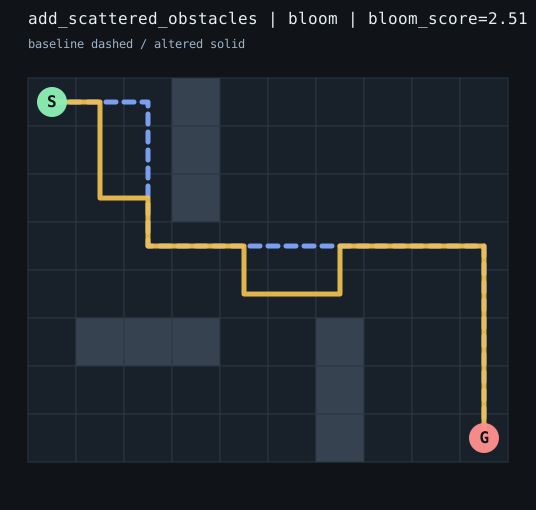
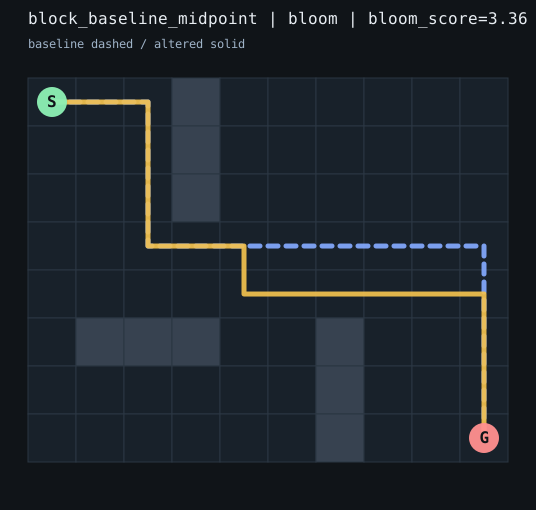
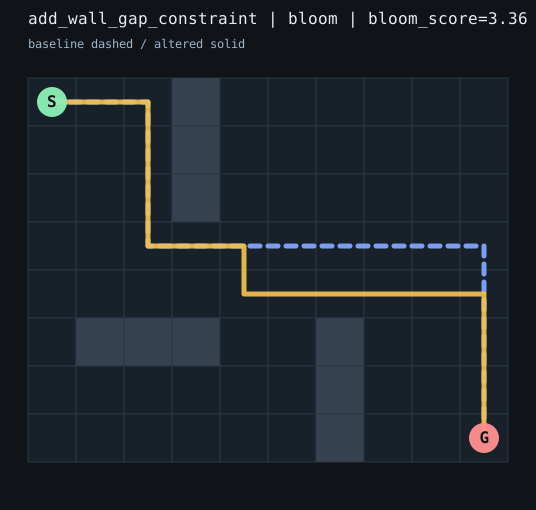
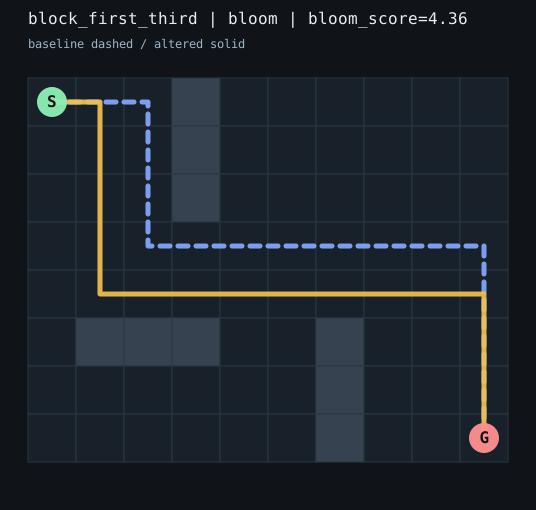
Four friction types tested across grid sizes from 5x5 to 15x15. Dashed blue shows the baseline L-shaped path. Solid gold shows the emergent adapted route. Bloom score shown in each title.
Wall Gap Constraint
add_wall_gap_constraint
Peak Bloom Score: 3.94 — Scale Invariant
Topological bottleneck forcing macro-level route deviation. The agent must abandon its horizontal traverse early to intercept specific coordinates. Most effective friction across all grid sizes — consistently produces Novelty scores above 0.6.
Block First Third
block_first_third
Avg Bloom Score: 3.06 — Bloom / Noise
Blockage in the first third of the traversal. Generates moderate adaptability but frequently results in Noise outcomes. Blockage versus gap efficiency — the agent can sometimes route around without global reconfiguration.
Scattered Obstacles
add_scattered_obstacles
Avg Bloom Score: 2.54 — Scale Dependent
High novelty (0.50) at 5x5 scale but degrades to Stable with 0.0 Novelty at 10x10 and above. Obstacle density decreases relative to grid area — at larger scales the agent bypasses without adapting.
Baseline Midpoint
block_baseline_midpoint
Avg Bloom Score: 2.24 — Stable
Consistently fails to provoke high-value adaptation. Disruption is localized at the midpoint of a long traverse — the agent performs a minor local optimization rather than a global route reconfiguration.
04

Dataset 001

Technical Evaluation — Dataset 001
40 Experiment Runs — Grid Sizes 5x5 to 15x15 — Four Friction Modalities

The first structured run set evaluated a Greedy Agent across scaled grid environments under four friction types. Key finding: structural bottlenecks (wall gaps) created stronger and more scale-invariant adaptation than stochastic perturbations (scattered obstacles). The dataset establishes baseline behavioral thresholds for all future Friction Bloom research.

Scale Invariance
add_wall_gap_constraint maintains consistent Novelty scores above 0.6 across all tested grid dimensions. Effective stressor regardless of search space size.
Scale Dependence
add_scattered_obstacles loses all utility in environments larger than 10x10 due to geometric sparsity. Obstacle density decreases relative to the square of grid dimension.
Kinematic Finding
Structural bottlenecks force global route reconfiguration. Stochastic perturbations produce local optimization. For maximum adaptability testing, use wall gaps over scattered obstacles.
View Technical Evaluation (PDF) →
05

Dataset 002

Technical Evaluation — Dataset 002
400 Experiment Runs — Greedy Agent — Four Friction Modalities

A 10x scale replication of Dataset 001. The same Greedy Agent, same friction modalities, same grid range — run at 400 experiments to confirm whether the behavioral patterns established at N=40 hold under increased statistical pressure. Confirmation study.

Replication
Primary findings from Dataset 001 confirmed at N=400. Wall gap constraint dominance over scattered obstacles holds across the expanded run set.
Statistical Weight
10x increase in run count provides meaningful reduction in variance. Behavioral thresholds established at N=40 prove stable under replication.
Baseline Confirmed
Dataset 001 findings were not artifacts of low sample size. The friction modality hierarchy is reproducible and consistent across independent run sets.
View Technical Evaluation (PDF) →
06

Dataset 003

Technical Evaluation — Dataset 003
4,000 Experiment Runs — Greedy Agent — Four Friction Modalities

Full-scale characterization study at N=4,000. At this volume, the complete distribution of each metric becomes visible — not just peaks and averages, but variance, tail behaviors, and the convergence point at which findings stabilize. The definitive behavioral profile of the Greedy Agent under Friction Bloom conditions.

Distribution
Full Bloom Score distributions characterized per friction type at scale. Variance and tail behaviors emerge that are statistically invisible at N=40 or N=400.
Convergence
Findings stabilize well below N=4,000 — confirming that the behavioral hierarchy observed across all three datasets is statistically robust and not dependent on run volume.
Scale Invariance
Wall gap constraint dominance remains consistent at full scale. The friction modality hierarchy established at N=40 holds without degradation across 100x the original sample.
View Technical Evaluation (PDF) → View Distribution Graphs (PDF) →